Three chords. That’s the whole toolkit behind blues, early rock ‘n’ roll, folk, country, and gospel, and it’s the first progression any musician, pianists included, should truly own. The I – IV – V progression is the sturdiest pattern in Western popular music, and stretched into the 12-bar blues it becomes one of the most-played forms on the planet. This is a deep dive into one progression and the famous form built on it; for the wider map of patterns it belongs to, see our guide to common piano chord progressions.
The I-IV-V progression at a glance
- In C major: C – F – G
- Roman numerals: I (major) – IV (major) – V (major)
- Sound: direct, sturdy, optimistic; it sounds like daylight
- Best for: blues, rock ‘n’ roll, folk, country, gospel, punk, three-chord songwriting
- Its most famous form: the 12-bar blues
What the numbers mean
The Roman numerals name each chord by its position in the key, so the pattern transfers to any key without relearning it. In C major the scale gives you C, Dm, Em, F, G, Am, B°, which makes the I, IV, and V chords C, F, and G. Move to G major and the same I-IV-V becomes G, C, and D. Learn the three shapes once, move them anywhere.
Why the I-IV-V progression works
Its power comes from a kind of completeness. The three major chords I, IV, and V between them contain every note of the major scale. Play all three and you’ve stated the entire key with no leftovers and no contradictions. That’s why the progression feels so grounded and final; there’s nothing hidden or unresolved about it.
The motion also has a built-in logic that maps onto the three chord families:
- I (C) is home: stable, at rest.
- IV (F) is the subdominant: it pulls gently away from the center, creating mild motion.
- V (G) is the dominant: maximum tension, leaning hard back toward home.
Send V straight back to I and you get the authentic cadence, the strongest resolution in tonal music. Everything about I-IV-V is that sentence writ large: rest, a step away, tension, and a decisive snap home. Because the pull of V→I is so satisfying, three chords are genuinely enough to carry a whole song.
The 12-bar blues
The single most important thing you can do with I-IV-V is arrange it into the 12-bar blues, a repeating 12-measure form that gives the three chords a story arc. The standard shape, counted one chord per bar, looks like this:

Read it as three four-bar lines. The first line sits on home (I). The second line steps up to IV and settles back to I. The third line delivers the drama: V is the peak of tension, IV eases it slightly, and I resolves, with that final bar of V (the turnaround) kicking you back to the top for another chorus.
A few standard variations you’ll hear constantly:
- Quick change (or quick four): play IV in bar 2 instead of staying on I, so the form breathes sooner.
- Turnaround: the last bar (or last two bars) uses V, or a little I-IV-I-V move, to pull the ear back around to bar 1.
- Dominant 7th color: blues almost always plays the chords as dominant 7ths (C7, F7, G7) rather than plain triads. Those added flat-7 notes are what give the blues its gritty, bittersweet bite.
That 12-bar template, plus a 12-bar lyric pattern (a line, the same line repeated, then a punchline), is the architecture under thousands of songs.
How to play it on piano
Start with plain root-position triads so the sound is in your ear:
- C: C – E – G
- F: F – A – C
- G: G – B – D
That works, but your hand leaps around. The smoother approach keeps your right hand in a small space and shares common tones while the left hand plays the root underneath. One easy voice-led option:
- C: (left hand C) right hand C – E – G
- F: (left hand F) right hand C – F – A
- G: (left hand G) right hand B – D – G
Notice how little the top of the chord moves. The rule of thumb: when you change chords, keep any shared notes where they are and move the rest the shortest distance possible.
To make it sound like actual blues rather than a hymn, do two things. First, turn the chords into dominant 7ths (C7 = C-E-G-B♭, F7 = F-A-C-E♭, G7 = G-B-D-F). Second, give the left hand a shuffle bass line instead of held chords: a bouncing, long-short “swung” pattern is the engine of piano blues and boogie-woogie.
The same progression in five common keys
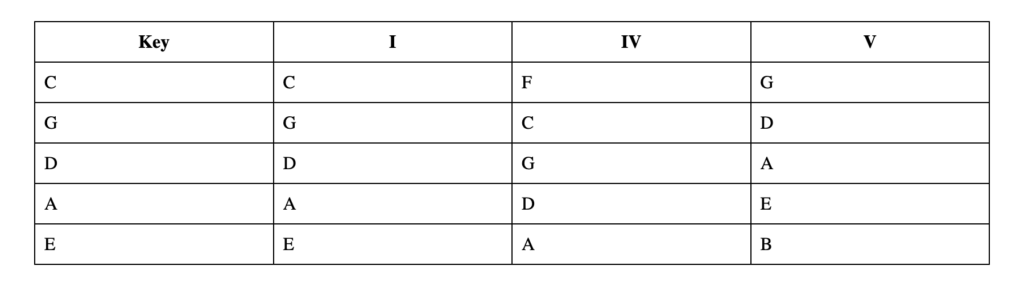
Learn it solidly in C first, then move it one key at a time. Blues and rock are very often played in E and A (guitar-friendly keys), while C, F, and B♭ show up a lot in piano and horn-based blues, so those are all worth having ready for jamming.
Songs that use the I-IV-V progression
Watch / listen (12-bar blues and rock ‘n’ roll): Elvis Presley, “Hound Dog” · Bill Haley, “Rock Around the Clock” · Stevie Ray Vaughan, “Pride and Joy” · Robert Johnson, “Sweet Home Chicago”
Watch / listen (three-chord songs beyond the blues): Ritchie Valens, “La Bamba” · The Kingsmen, “Louie Louie” · Johnny Cash, “Folsom Prison Blues”
These songs span 1930s Delta blues, 1950s rock ‘n’ roll, garage rock, and outlaw country, yet they all lean on the same three chords. That range is the point: I-IV-V is a plain, reliable frame, and the genre comes from tempo, feel, and instrumentation rather than the harmony itself.
How to make it your own
Three chords sound basic only if you play them basically. A few ways to open it up:
Add the 7ths (and beyond). Dominant 7ths are the baseline blues sound; from there, 9th chords (C9, F9) add even more grit and are a staple of soul and funk.
Play a shuffle or boogie bass. A walking or boogie-woogie left-hand pattern turns three static chords into a driving groove all by itself. This, more than anything, is what separates blues piano from a beginner’s block chords.
Try the minor blues. Swap to minor chords over the same 12-bar skeleton (i-iv-v, often with a V7 for punch) and you get the darker, smokier sound behind tunes like “The Thrill Is Gone.”
Use the blues scale on top. Improvise a right-hand melody from the blues scale (in C: C-E♭-F-G♭-G-B♭) over the loop. Because I-IV-V states the whole key so clearly, it’s the friendliest possible bed for a first solo.
Change the harmonic rhythm. Not every blues is 12 bars at one chord per measure. Try an 8-bar blues, or stretch and compress how long each chord lasts to reshape the feel.
Practice tips
Learn the plain triads in C until the changes are automatic, then add the flat-7 to make them dominant chords and put a simple shuffle in the left hand. Play the full 12-bar form as a loop, counting the bars out loud until the shape is memorized; that internal map is what lets you jam with other players. Once it’s comfortable in C, move to G and E. Finally, put on one of the songs above and play along by ear, which trains your timing and listening far faster than drilling in isolation. If you want guided, song-based practice, an interactive app can shorten the path; see our pick for the best app to learn piano chords.
The I-IV-V cadence also sits at the historical root of a more sophisticated relative, the jazz ii-V-I progression, which swaps the raw IV for a smoother predominant. And if you’re wondering why a mere three or four chords can carry so much of popular music while classical composers rarely loop this way, we tell that story in why pop songs use the same chords.
Frequently asked questions
What is the I-IV-V progression? It’s a three-chord pattern built on the first, fourth, and fifth notes of a key. In C major it’s C, F, and G. Together those three major chords contain every note of the scale, which is why the progression sounds so complete and grounded, and it’s the foundation of blues, folk, and early rock.
What is the 12-bar blues? It’s a 12-measure musical form built almost entirely from the I, IV, and V chords. A standard version in C is four bars of C, two of F, two of C, then G, F, C, and a G turnaround. Repeating this 12-bar cycle, usually with dominant 7th chords, underpins thousands of blues and rock ‘n’ roll songs.
What songs use the I-IV-V progression? Countless ones across many styles: “Hound Dog,” “Rock Around the Clock,” “Pride and Joy,” and “Sweet Home Chicago” are 12-bar blues, while “La Bamba,” “Louie Louie,” and “Folsom Prison Blues” show the same three chords outside the blues.
Why does blues use dominant 7th chords? Blues plays I, IV, and V as dominant 7ths (like C7, F7, G7) rather than plain triads. The added flat-7 note creates a gentle, unresolved tension on every chord, which produces the characteristic gritty, bittersweet “blue” sound the style is named for.
What key is easiest to play I-IV-V in? C major is easiest on piano because C, F, and G use mostly white keys. E and A are the classic blues and rock keys for guitar-based jamming, so they’re worth learning next.
Part of our series on common piano chord progressions.