If jazz harmony has a homeward route, this is it. The ii-V-I progression moves from preparation to tension to release in three chords, and it appears in standards so often that jazz musicians learn to recognize it as a single unit. In C major, the chords are Dm7-G7-Cmaj7. Learn that sound and you will begin hearing the hidden grammar beneath countless tunes.
This guide focuses on the cadence itself. For the wider family it belongs to, start with our map of common piano chord progressions.
The ii-V-I progression at a glance
- In C major: Dm7-G7-Cmaj7
- Roman numerals: ii7-V7-Imaj7
- Chord functions: predominant-dominant-tonic
- Root motion: down a perfect fifth each time (D-G-C)
- Sound: smooth, sophisticated, and conclusively resolved
- Best for: jazz standards, swing, bossa nova, soul, R&B, and richer pop harmony
What the numbers mean
The numerals identify each chord by its place in the major scale. In C major:

The second chord is minor, so it uses lowercase ii. The fifth is a dominant seventh, V7. The first is the tonic major seventh, Imaj7. Move the pattern to F major and ii-V-I becomes Gm7-C7-Fmaj7. The relationships stay the same even when the letter names change.
Why the ii-V-I progression works
Three forces make this cadence unusually strong.
The roots fall by fifths
D moves to G, and G moves to C. Downward motion by perfect fifth is one of the strongest root relationships in tonal harmony. Each new root feels like the natural destination of the previous chord.
The V7 contains a tritone
In G7 (G-B-D-F), the notes B and F form a tense interval called a tritone. When G7 resolves to Cmaj7, B rises one half-step to C while F falls one half-step to E. Those two tiny movements turn instability into the defining notes of the tonic chord.
The ii chord prepares the dominant
Dm7 contains D and F, two notes that continue into G7. Its F also anticipates one side of the dominant’s tritone. The result is not three unrelated blocks but a continuous line: ii sets up V, V demands I, and I provides release.
That sequence of functions – preparation, tension, resolution – is why the progression feels like a complete sentence.
How to play ii-V-I on piano
Begin with root-position seventh chords:
- Dm7: D-F-A-C
- G7: G-B-D-F
- Cmaj7: C-E-G-B
These spell the harmony clearly, but the right hand jumps. A smoother beginner voicing puts roots in the left hand and compact shapes in the right:
- Dm7: left hand D; right hand F-A-C-E (Dm9 without the root)
- G7: left hand G; right hand F-A-B-D (G9 without the root)
- Cmaj7: left hand C; right hand E-G-B-D (Cmaj9 without the root)
The right hand barely moves. F stays in place from Dm7 to G7 while C falls to B; then F falls to E and A falls to G as the dominant resolves. Jazz pianists often omit roots from the right hand because a bass player or the pianist’s left hand already supplies them.
A simple shell-voicing version
If four-note shapes feel crowded, play only the third and seventh of each chord:
- Dm7: F-C
- G7: F-B
- Cmaj7: E-B
These shell voicings retain the notes that identify each chord’s quality and function. Add roots in the left hand, then add color tones only after the voice leading feels automatic.
The progression in five common keys
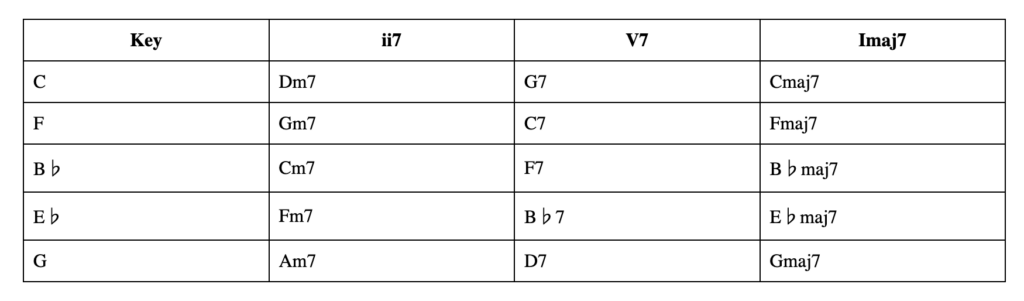
Jazz standards frequently move through several keys, so do not stop at C. Practice around the circle of fifths: C, F, B♭, E♭, A♭, and onward. The pattern under your fingers will eventually become more important than any single chord name.
Songs and standards that use ii-V-I
The cadence may appear at the end of a phrase, pass quickly through a temporary key, or chain into another ii-V-I rather than repeating as a simple loop.
Watch / listen: Joseph Kosma, “Autumn Leaves” · Bart Howard, “Fly Me to the Moon” · Jerome Kern, “All the Things You Are” · Duke Ellington, “Satin Doll”
“Autumn Leaves” is especially useful for practice because it moves through connected ii-V-I patterns in the relative major and minor keys. “Satin Doll” makes the ii-V motion easy to hear before the progression resolves.
ii-V-I is a move, not usually a whole song
Unlike a repeating four-chord pop progression, ii-V-I often acts as a short route to a destination. A composer can temporarily treat any chord as a new tonic and precede it with that chord’s own ii-V.
For example, a tune in C major might approach Am with Bm7♭5-E7-Am. The E7 contains G♯, a note outside C major, because it briefly treats A as home. This is called tonicization, and chains of these temporary destinations are a major reason jazz standards seem to change key so fluidly.
The descending-fifths root motion also connects ii-V-I to longer cycles such as the Pachelbel progression and circle-of-fifths sequences, though those patterns use the motion in different ways.
The minor ii-V-i progression
In a minor key, the cadence changes quality. In C minor:
- iiø7: Dm7♭5 (D-F-A♭-C)
- V7: G7 or G7♭9 (G-B-D-F, optionally A♭)
- i: Cm or Cm(maj7)
The symbol ø means half-diminished: a diminished triad plus a minor seventh. The major B in G7 comes from harmonic minor and acts as the leading tone, pulling upward to C. Adding A♭ creates G7♭9, a tense dominant that contains several half-step resolutions into Cm.
The minor version sounds darker and more dramatic than major ii-V-I, but its grammar is identical: prepare, tense, resolve.
Common variations
Add extensions. Turn Dm7-G7-Cmaj7 into Dm9-G13-Cmaj9. The function stays intact while the voicing gains color.
Alter the dominant. Use G7♭9, G7♯9, G7♭5, or G7♯5 before C. Alterations intensify the dominant and create extra half-step resolutions.
Use a tritone substitution. Replace G7 with D♭7. The two chords share the same tritone (B-F, enharmonically C♭-F), while the bass descends chromatically D-D♭-C.
Delay the tonic. Insert another ii-V pair or resolve deceptively to a related chord. Jazz arrangements often prolong the journey instead of taking the first available route home.
How to practice it
- Play root-position Dm7-G7-Cmaj7 and sing each root.
- Switch to shell voicings and listen for F moving down to E and B moving up to C.
- Practice one compact voicing through five keys.
- Add a metronome and give each chord four beats, then two beats.
- Find the cadence in a standard and mark each ii, V, and I on the lead sheet.
- Practice the minor version separately so the half-diminished ii chord becomes familiar.
The raw I-IV-V cadence is the simpler ancestor of this motion. Compare the two in our guide to the I-IV-V progression and 12-bar blues: IV and ii both prepare the dominant, but ii7 creates smoother voice leading into V7.
If you want a chord method, advanced voicing reference, or guided theory course, compare our picks for the best piano chord books and learning tools.
Frequently asked questions
What is the ii-V-I progression? It is a three-chord cadence built on the second, fifth, and first degrees of a key. In C major, it is Dm7-G7-Cmaj7. It is the most common harmonic building block in jazz.
Why is ii-V-I so common in jazz? Its roots descend by perfect fifths, the ii chord smoothly prepares V7, and the tritone inside V7 resolves by half-step into I. That combination creates strong direction with very economical voice leading.
How do you practice ii-V-I in all keys? Learn one compact voicing, then move it around the circle of fifths. Start slowly with one chord per bar, name the key and function aloud, and add tempo only when the voice leading remains smooth.
What is the difference between ii-V-I and 2-5-1? There is no difference. “2-5-1” is the spoken or Arabic-numeral name for ii-V-I. Roman numerals also show chord quality: lowercase ii is minor, uppercase V is major or dominant, and uppercase I is major.
What is a minor ii-V-i progression? In C minor, it is Dm7♭5-G7-Cm. The ii chord is half-diminished, and the V chord usually uses the raised seventh from harmonic minor so B pulls strongly up to C.
Can ii-V-I be used outside jazz? Yes. It appears in classical harmony, bossa nova, soul, R&B, musical theater, and harmonically rich pop. Jazz made it a named, reusable unit, but the underlying predominant-dominant-tonic motion is centuries old.
Part of our series on common piano chord progressions.